
The IRS recently announced its yearly tax inflation adjustments for 2020. These are the numbers for the tax year 2020 beginning January 1, 2020, that you’ll use to prepare your 2020 tax returns in 2021. The income tax brackets, standard deduction amounts, and other tax items adjusted annually for cost-of-living increases of most interest to our clients are below.
Tax Brackets and Tax Rates by Filing Status:

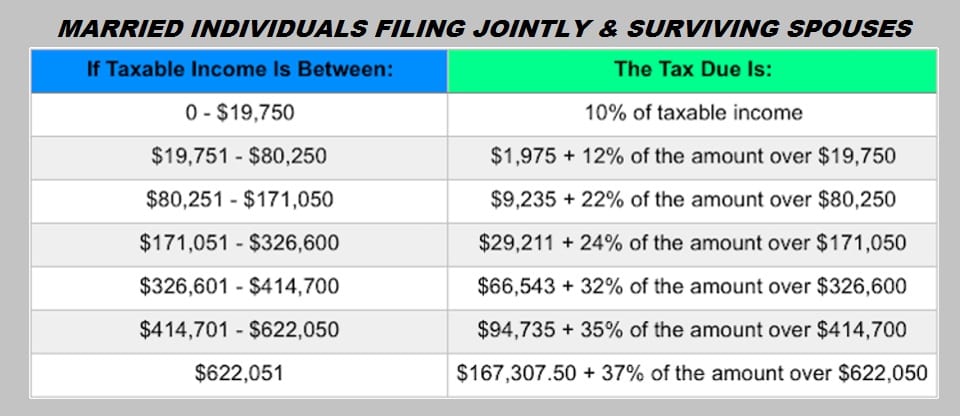

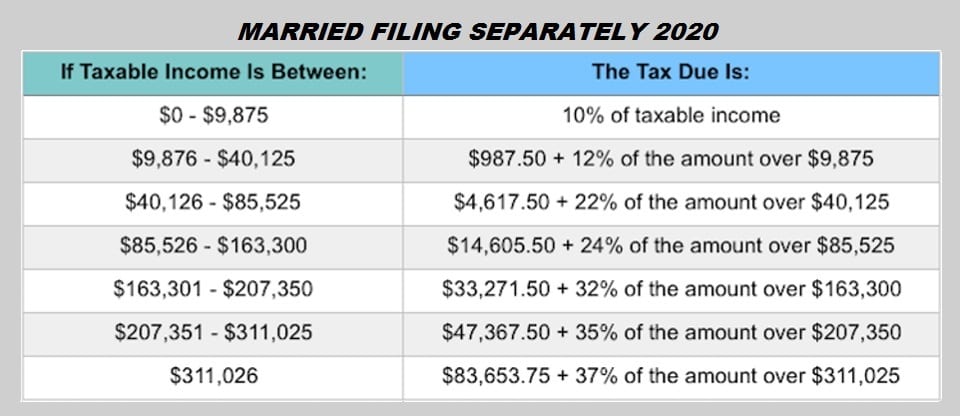
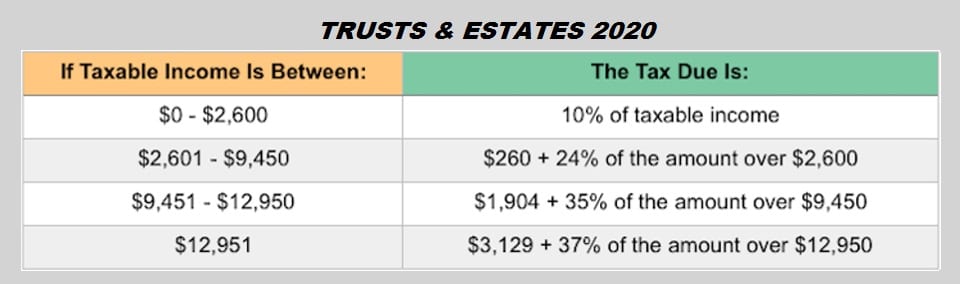

Additional Items:
• For 2020, the standard deduction amount remains the same for an individual who may be claimed as a dependent by another taxpayer cannot exceed the greater of $1,100 or $350 plus the individual’s earned income, whichever is greater. However, the standard deduction may not exceed the regular standard deduction for that individual.
• There will be no personal exemption amount for 2020. The personal exemption amount remains zero under Tax Reform.
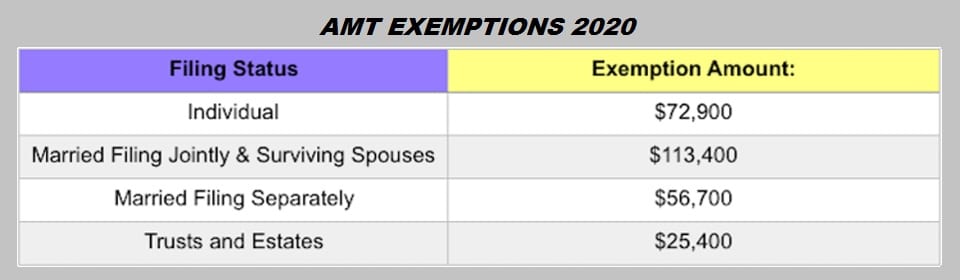
The AMT will look like this:
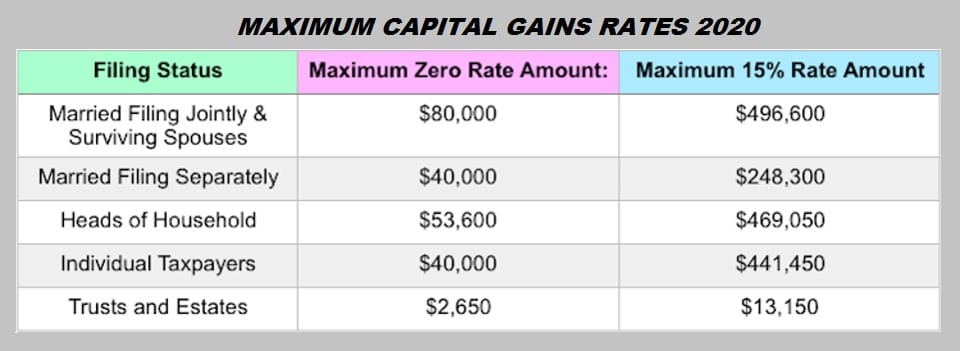
Capital Gains rates will not change for 2020, but the brackets for the rates will change. Most taxpayers pay a maximum 15% rate, but a 20% tax rate applies if your taxable income exceeds the thresholds set for the 37% ordinary tax rate. Exceptions also apply for art, collectibles and section 1250 gain (related to depreciation). The maximum zero rate amounts and maximum 15% rate amounts break down as follows:
There are changes to itemized deductions found on Schedule A, including:
• State and Local Taxes. Deductions for state and local sales, income, and property taxes remain in place for 2020 and are limited to a combined total of $10,000, or $5,000 for married taxpayers filing separately.
• Home Mortgage Interest. You may only deduct interest on acquisition indebtedness – your mortgage used to buy, build or improve your home – up to $750,000, or $375,000 for married taxpayers filing separately.
• Charitable donations. As a result of tax reform, the percentage limit for charitable cash donations to public charities increased from 50% to 60% in 2018 and will remain at 60% for 2020.
Some tax credits and deductions have been adjusted for 2020, including:
• Earned Income Tax Credit (EITC). For 2020, the maximum EITC amount available is $6,660 for married taxpayers filing jointly who have three or more qualifying children. $538 for married taxpayer with no children. Phase-outs apply.
• Adoption Credit. For 2020, the credit for an adoption of a child with special needs is $14,300, and the maximum credit allowed for other adoptions is the amount of qualified adoption expenses up to $14,300. Phase-outs apply.
• Student Loan Interest Deduction. For 2020, the maximum amount that you can deduct for interest paid on student loans remains $2,500. • Lifetime Learning Credit. For the 2020 tax year, the adjusted gross income (AGI) amount for joint filers to determine the reduction in the Lifetime Learning Credit is $118,000; the AGI amount for single filers is $59,000.
• Foreign Earned Income Exclusion. For tax year 2020, the foreign earned income exclusion is $107,600 up from $105,900 for tax year 2019.
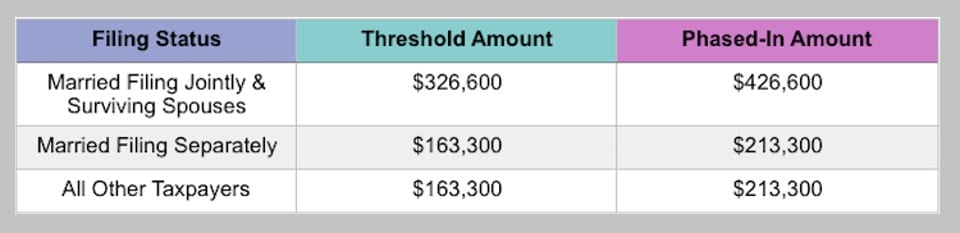
• Section 199A Qualified Business Income (QBI). As part of the TCJA, sole proprietors and owners of pass-through businesses are eligible for a deduction of up to 20% for qualified business income. The deduction is subject to threshold and phased-in amounts. For 2020, the threshold amounts begin at $326,600 for married taxpayers filing jointly:
Other Items of Interest:
• The annual exclusion for gifts is $15,000 for calendar year 2020, as it was for calendar year 2019.
• Excess Business Loss Disallowance Rule. Under Code Sec. 461(l), an excess business loss for the tax year is the excess of aggregate deductions of the taxpayer attributable to the taxpayer’s trades and businesses, over the sum of aggregate gross income or gain of the taxpayer plus a threshold amount. For 2020, the threshold amount is $518,000 for married individuals filing jointly (up from $510,000 for 2019) and $259,000 for other individuals (up from $255,000 for 2019).
• Qualified Transportation Fringe Benefits. For 2020, an employee will be able to exclude up to $270 (up from $265 for 2019) a month for qualified parking expenses, and up to $270 a month (up from $265 for 2019) of the combined value of transit passes and transportation in a commuter highway vehicle.
• The exemption from the kiddie tax for 2020 will be $2,200 (same as for 2019). A parent will be able to elect to include a child’s income on the parent’s return for 2020 if the child’s income is more than $1,100 and less than $11,000 (same as for 2019).
• For the taxable years beginning in 2020, the dollar limitation for employee salary reductions for contributions to health flexible spending accounts is $2,750, up $50 from the limit for 2019.
• For tax year 2020, participants who have self-only coverage in a Medical Savings Account, the plan must have an annual deductible that is not less than $2,350, the same as for tax year 2019; but not more than $3,550, an increase of $50 from tax year 2019. For self-only coverage, the maximum out-of-pocket expense amount is $4,750, up $100 from 2019. For tax year 2020, participants with family coverage, the floor for the annual deductible is $4,750, up from $4,650 in 2019; however, the deductible cannot be more than $7,100, up $100 from the limit for tax year 2019. For family coverage, the out-of-pocket expense limit is $8,650 for tax year 2020, an increase of $100 from tax year 2019.
• The contribution limit for employees who participate in 401(k), 403(b) plans is increased from $19,000 to $19,500. The catch-up contribution limit for employees aged 50 and over who participate in these plans is increased from $6,000 to $6,500. The income ranges for determining eligibility to make deductible contributions to traditional Individual Retirement Arrangements (IRAs), and to contribute to Roth IRAs, when covered by an employer retirement plan increased for 2020.
Contact Us: Not expecting any significant changes in 2020? Let us help you use the updated numbers to estimate your tax liability and then minimize it. If you plan to make more money, or get married, divorce, start or buy a business, or have a baby, let’s do some tax planning ahead of time to put you in the BEST possible position. Contact us toll free: 855-534-2727.